Subtotal
$0.00Home Ventilation for Energy-Efficient Homes: HRV vs ERV Explained
Published: August 2024 · Last updated: October 2026 · Category: Knowledge Base
By Ragnar Palm, CEO & Principal Civil Engineer — Nordic Home Plans
We spend about 90% of our time indoors, according to the U.S. Environmental Protection Agency, so the air inside our homes matters. Modern energy-efficient homes are built airtight to save energy, which means fresh air no longer leaks in through gaps in the walls and around windows. Without a planned way to bring fresh air in and take stale air out, moisture and pollutants build up inside.
Whole-house ventilation is a mechanical system that continuously supplies fresh outdoor air to a home and removes stale, humid air from it. In the energy-efficient homes we design, it is a balanced system with heat recovery: a heat recovery ventilator (HRV) or an energy recovery ventilator (ERV), known in the UK and parts of Europe as MVHR.
This article explains how home ventilation works in an airtight house: why it needs mechanical ventilation, how an HRV and an ERV work, how to choose between them, and what to do if your current home shows signs of poor ventilation.
Key Takeaways
- Energy-efficient homes are built airtight, so they need a planned supply of fresh air instead of relying on leaks.
- A heat recovery ventilator (HRV) or energy recovery ventilator (ERV) exchanges stale indoor air for filtered fresh air while recovering heat from the outgoing air.
- The difference: an ERV also transfers some moisture, which helps keep indoor humidity more constant.
- Under the 2021 International Residential Code, every home built to the energy code’s air-leakage requirements must have mechanical ventilation.
- Our published Signature Plans specify an ERV, and a locally licensed professional sizes the system for your climate and local code.
Why Energy-Efficient Homes Need Whole-House Ventilation
Older homes were drafty. Air leaked in through gaps around windows, doors and joints, and that uncontrolled air exchange was their ventilation, at the cost of heat loss, drafts and cold spots. An energy-efficient home seals those gaps on purpose. That keeps heat in and drafts out, but it also means fresh air has to be brought in deliberately.
Building codes reflect this. Under the 2021 International Residential Code (Section R303.4), every home built to the energy code’s air-leakage requirements must have mechanical ventilation. Earlier editions required it once a blower-door test showed 5 air changes per hour or less at 50 pascals. Codes for colder climates can be stricter still: Larimer County, Colorado, for example, requires 3 air changes per hour or less. In Canada, Subsection 9.32.3 of the National Building Code sets the requirements for a house’s mechanical ventilation system.
Mechanical ventilation can be exhaust-only, supply-only or balanced. Exhaust-only systems pull air out with fans and let replacement air leak in wherever it can, and they can backdraft gas appliances such as draft-hood water heaters and fireplaces. Balanced systems move the same amount of air in and out through ducts, which is why we design airtight homes with balanced ventilation.
How an HRV Works
Heat recovery ventilation uses a heat recovery ventilator, often simply called an HRV system. It has two fans, filters and a heat exchanger. One fan draws stale air from the kitchen, bathrooms and laundry; the other brings fresh outdoor air in through a filter and supplies it to the living room and bedrooms. Inside the unit, the two airstreams pass each other in the heat exchanger without mixing. In winter, the outgoing warm air heats the incoming cold air; in summer, the cooler indoor air takes some heat out of the incoming air.
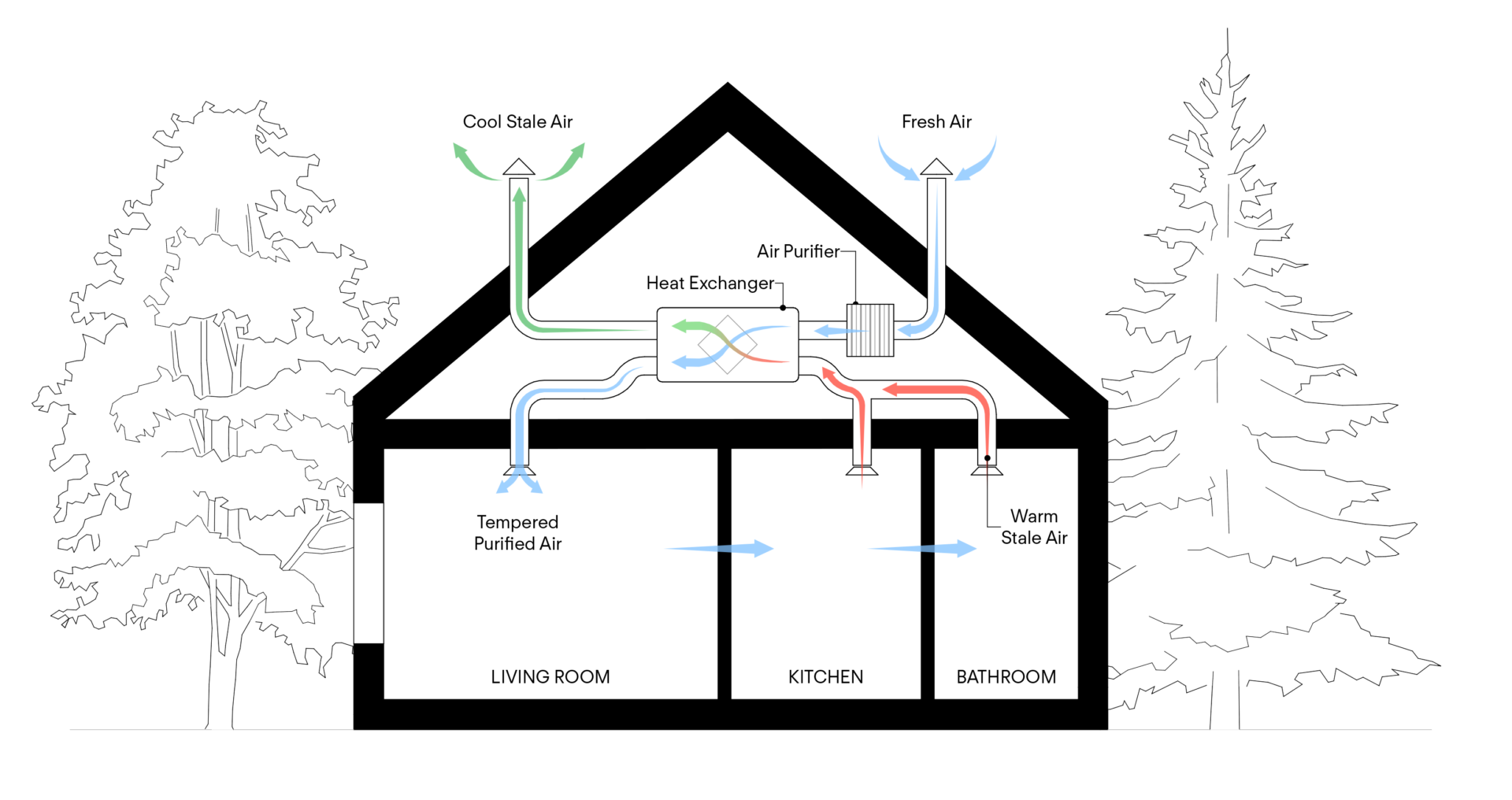
The system typically runs continuously at low speed. In the UK and parts of Europe it is called MVHR, mechanical ventilation with heat recovery.
HRV vs ERV: What Is the Difference?
Both an HRV and an energy recovery ventilator (ERV) have a heat exchanger, fans and controls. The difference is moisture: according to the U.S. Department of Energy, an ERV also transfers some water vapor between the airstreams, which helps keep indoor humidity more constant.
- HRV: recovers heat only. Moist indoor air is exhausted, so in winter it typically keeps the house drier.
- ERV: recovers heat and some moisture. In winter it keeps more humidity indoors, and in humid summers it typically brings less moisture in.
According to the U.S. Department of Energy, balanced ventilation is appropriate for all climates, and heat or energy recovery is most cost-effective where winters or summers are extreme and energy costs are high. In mild climates, the electricity used by the fans can outweigh the savings.
Two practical points matter for long-term performance. In cold climates the unit needs frost protection, because very cold supply air can freeze in the heat exchanger. And HRVs and ERVs need more maintenance than simpler systems: the filters and the core must be cleaned regularly, or airflow and heat recovery drop.
Which one is right depends on your climate, your household and how airtight the home is. Our Signature Plans specify an ERV, and for each project a locally licensed professional sizes the system for your climate and local code.
How Good Ventilation Supports Health and Comfort
Good ventilation removes moisture, carbon dioxide and indoor pollutants such as volatile organic compounds (VOCs) from cooking, cleaning products and furnishings. In a Harvard study of 24 office workers over six days, cognitive test scores were 101% higher in a well-ventilated, low-pollutant environment than in conventional conditions.
Humidity matters too. The EPA recommends keeping indoor relative humidity below 60%, ideally between 30% and 50%. Dust mites, the source of one of the most powerful indoor allergens, grow in damp, warm conditions, and the key to mold control is moisture control.
Cognitive test scores were 101% higher in a well-ventilated, low-pollutant office than in conventional conditions.
6 Signs of Poor Ventilation in Your Home
Recognizing the signs early lets you fix the problem before it affects your health or the house itself:
- Condensation on windows: moisture is trapped inside and can lead to mold.
- Musty odors: often a sign of mold or mildew.
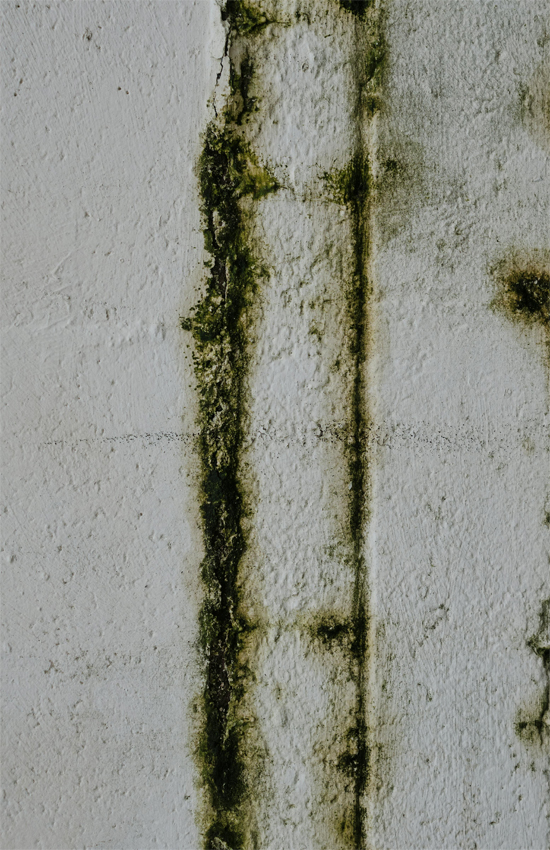
- Visible mold on walls, ceilings or around windows.
- Stuffy, stale air, especially in bedrooms in the morning.
- Indoor humidity that stays above 60%, the EPA’s upper limit.
- Dust that builds up quickly, which can point to poor filtration or air circulation.


How to Improve Ventilation in an Existing Home
If you live in an existing home, these steps improve indoor air quality:
- Use exhaust fans in bathrooms and the kitchen, and make sure they vent outdoors, not into the attic.
- Open windows when the weather allows. A few minutes of cross-ventilation clears stale air.
- Control humidity with a dehumidifier in damp areas such as basements.
- Service your heating and cooling equipment, and replace filters as the manufacturer recommends.
- Use an indoor air quality monitor to track carbon dioxide and humidity.
- For a major renovation or a new home, plan a balanced ventilation system with heat recovery.

How We Plan Ventilation in Our Designs
We plan ventilation into every design from the start, because the airtight, well-insulated envelope and the ventilation system work together. Our published Signature Plans, Aurora, Solaris and Lumina, specify an energy recovery ventilator (ERV) together with ENERGY STAR exhaust fans. Read more about the envelope in our article on superior insulation and about the whole-house approach in the benefits of energy-efficient Scandinavian homes.
For your project, a locally licensed professional sizes the ventilation system for your climate and local code. To see how this works in practice, explore our Signature Plans or our custom home design service.
Frequently Asked Questions
A heat recovery ventilator (HRV) is a whole-house ventilation unit that brings in fresh outdoor air and exhausts stale indoor air through a heat exchanger, so the outgoing air warms the incoming air in winter. It has fans, filters and controls, and typically runs continuously at low speed.
Both exchange heat between the outgoing and incoming air. An energy recovery ventilator (ERV) also transfers some moisture, which helps keep indoor humidity more constant. Which one fits depends on your climate and household, and a locally licensed professional sizes the system for your home.
Yes. Under the 2021 International Residential Code (Section R303.4), homes built to the energy code’s air-leakage requirements must have mechanical ventilation. Earlier editions required it once a home tested at 5 air changes per hour or less at 50 pascals. Energy-efficient homes are designed to be airtight, so in practice they need it.
The EPA recommends keeping indoor relative humidity below 60%, ideally between 30% and 50%, to limit mold and dust mites.
MVHR stands for mechanical ventilation with heat recovery. It is the name used in the UK and parts of Europe for a balanced ventilation system with heat recovery, called an HRV or ERV in North America.
Yes. Our Signature Plans specify an energy recovery ventilator (ERV) and ENERGY STAR exhaust fans, and a locally licensed professional sizes the system for your site and local code.
Planning a healthy, energy-efficient home?
The best place to start is a conversation. Book a free design call and we’ll talk through your site, climate, lifestyle, and how ventilation, insulation and heating will work together in your new home.
Prefer to explore first?
- Browse our Signature House Plans if you want a strong architectural concept that can be adapted to your site.
- Explore our Custom Home Design path if you want a one-of-a-kind home designed around your lifestyle, land, and climate.

About the Author
Ragnar Palm — CEO & Principal Civil Engineer, Nordic Home Plans
Ragnar is the CEO and principal civil engineer at Nordic Home Plans, a Northern European architecture studio specializing in modern, energy-efficient Scandinavian-style homes. He leads the engineering side of the studio’s work, from the building envelope to energy performance. Learn more about Ragnar and the studio.